What’s the Difference Between a PoE Switch and a PoE Injector?
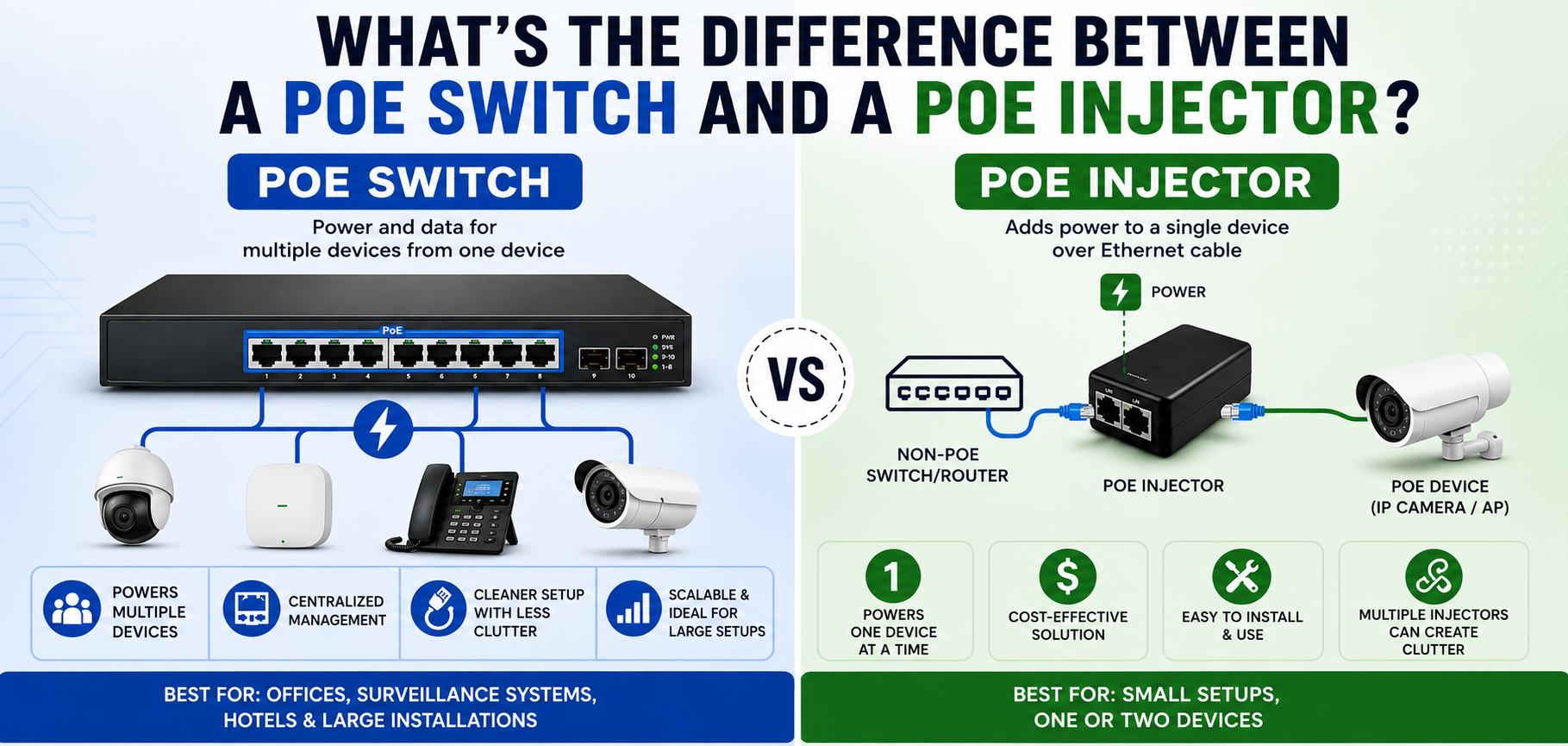
Learn the difference between a PoE switch and a PoE injector. Compare setup, scalability, cost, and best use cases for IP cameras and network devices.
When you’re setting up IP cameras, accessing factors, VoIP phones, and other location devices, you’ll often come across terms like PoE Switch and PoE Injector. Both are used to deliver Power over Ethernet (PoE), meaning they deliver energy and data each through an unmarried LAN cable. While they share the same motivation, their usability, scalability, and practicality are quite special.
A PoE Switch is a network transfer that has integrated PoE capability. It connects multiple devices like IP cameras, access factors, and different PoE-enabled devices, and gives both electricity and statistics to all of them thru Ethernet cables. This makes it a great solution for workplaces, surveillance systems, lodges, and huge installations in which more than one gadget needs to be powered. The largest advantage of a PoE transfer is centralized management: it reduces wiring muddle, eliminates the need for separate energy adapters, and ensures stable performance across all linked devices. It also supports scalability, meaning you could join many devices relying on the range of ports available. However, PoE switches are noticeably higher priced in advance in comparison to injectors.
On the other hand, a PoE Injector is a small tool used to feature electricity to a single Ethernet cable. It sits between your non-PoE switch/router and the PoE tool, injecting electricity into the cable so that the device can function without a separate electricity supply. PoE injectors are high-quality, ideal for small setups where you simplest want to strengthen one or gadgets, such as an unmarried IP camera or get right of entry to point. The important benefit is cost-effectiveness and simplicity. It's a short solution while not having to update your current community switch. However, it will become impractical for large setups due to the fact each device requires a separate injector, leading to more wiring and much less green control.
Before selecting among a PoE transfer and a PoE injector, you must recall a few critical factors. First is the variety of devices if you have a couple of gadgets, a PoE transfer is the higher desire, while injectors are appropriate for one or gadgets. Second is scalability PoE switches allow smooth growth, while injectors are constrained. Third is installation and cable control switches provide a cleanser and more organized setup, even as injectors can create muddle in large deployments. Fourth is the budget injectors are inexpensive to start with, however for multiple gadgets, a PoE transfer turns into more fee-efficient ultimately. Lastly, recollect use cases for professional installations like CCTV initiatives, a PoE switch is noticeably endorsed, even as for small or transient setups, injectors work flawlessly fine.
In simple terms, a PoE switch is a complete solution for powering multiple devices efficiently, while a PoE injector is a simple add-on for powering individual devices. Choosing the right option depends on your setup size, future expansion plans, and budget.